
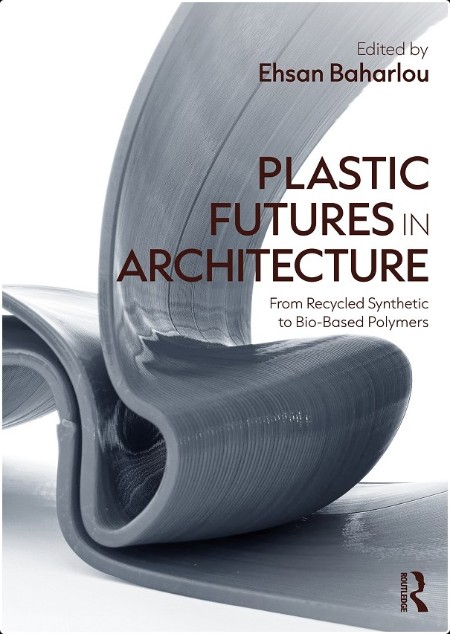
Plastic Futures in Architecture From Recycled Synthetic to Bio – Based Polymers | 246.11 MB
Title: Plastic Futures in Architecture From Recycled Synthetic to Bio – Based Polymers
Author: Baharlou, Ehsan
Category: Sustainability & Green Design, Materials Science
Language: English | 233 Pages | ISBN: 978-1040614549
Description:
This volume details the recent efforts of developing sustainable approaches to reclaim synthetic polymers and explore natural polymers in design production. Not long ago, plastic was envisioned as a miraculous material. Now plastic pollution has become an inseparable part of the environment. How can the built environment make use of this prolific and ‘miraculous’ material in an environmentally responsible way? Plastic Futures in Architecture focuses on plastic derivatives and complications in three main modes: Being, Becoming, and Beyond. “Being” presents the concerns and prospects of plastic continuation. “Becoming” provides insight into the technological advancements in the processing and production of plastic in the built environment. “Beyond” discusses the experimental transformation of plastic applications from synthetic polymers to more sustainable polymers in design. It focuses on projects that outline a journey from awareness to innovation, recycling synthetic polymers and exploring the use of bio-based natural polymers through rapidly developing digital crafting capabilities and techniques. These project discussions will serve as an invaluable resource for students, educators, architects, product designers, practitioners in global sustainability, material innovation, digital fabrication technologies, and computational design. Ehsan Baharlou, Dr.-Ing., is an Assistant Professor of Architecture and the Director of Computational Tectonics Lab at the School of Architecture, University of Virginia. His research agenda unfolds through three interconnected streams: Computationally Driven Material Ecologies, Circular Robotic Fabrication for Performance and Living, and Regenerative Architecture. He investigates regenerative architectural technologies across scales-from microscale material formulations to full-scale assemblies. His work has been internationally exhibited at the French Pavilion in Venice Biennale 2025 and at the 2025 Chicago Architecture Biennial. He has also co-edited a special issue of the International Journal for Architectural Computing (IJAC), advancing computational design discourse by foregrounding ecological levers such as autonomy and interdependence.
This volume details the recent efforts of developing sustainable approaches to reclaim synthetic polymers and explore natural polymers in design production. Not long ago, plastic was envisioned as a miraculous material. Now plastic pollution has become an inseparable part of the environment. How can the built environment make use of this prolific and ‘miraculous’ material in an environmentally responsible way? Plastic Futures in Architecture focuses on plastic derivatives and complications in three main modes: Being, Becoming, and Beyond. “Being” presents the concerns and prospects of plastic continuation. “Becoming” provides insight into the technological advancements in the processing and production of plastic in the built environment. “Beyond” discusses the experimental transformation of plastic applications from synthetic polymers to more sustainable polymers in design. It focuses on projects that outline a journey from awareness to innovation, recycling synthetic polymers and exploring the use of bio-based natural polymers through rapidly developing digital crafting capabilities and techniques. These project discussions will serve as an invaluable resource for students, educators, architects, product designers, practitioners in global sustainability, material innovation, digital fabrication technologies, and computational design. Ehsan Baharlou, Dr.-Ing., is an Assistant Professor of Architecture and the Director of Computational Tectonics Lab at the School of Architecture, University of Virginia. His research agenda unfolds through three interconnected streams: Computationally Driven Material Ecologies, Circular Robotic Fabrication for Performance and Living, and Regenerative Architecture. He investigates regenerative architectural technologies across scales-from microscale material formulations to full-scale assemblies. His work has been internationally exhibited at the French Pavilion in Venice Biennale 2025 and at the 2025 Chicago Architecture Biennial. He has also co-edited a special issue of the International Journal for Architectural Computing (IJAC), advancing computational design discourse by foregrounding ecological levers such as autonomy and interdependence.
DOWNLOAD:
rapidgator.net/file/e145543d3af8a500439da292afe2bb36/Plastic_Futures_in_Architecture_26_07_10_09_03_47.rar
nitroflare.com/view/4F5B03160B987EB/Plastic_Futures_in_Architecture_26_07_10_09_03_47.rar
